



SCENE
(ENG)The Artist Duo Who Writes Poetry
in Midair
- 저자
- 글_에이스퀘어 (편집부)
- 발행일
- 2025-11-27
How Kimchi and Chips Creates Art Through Technology
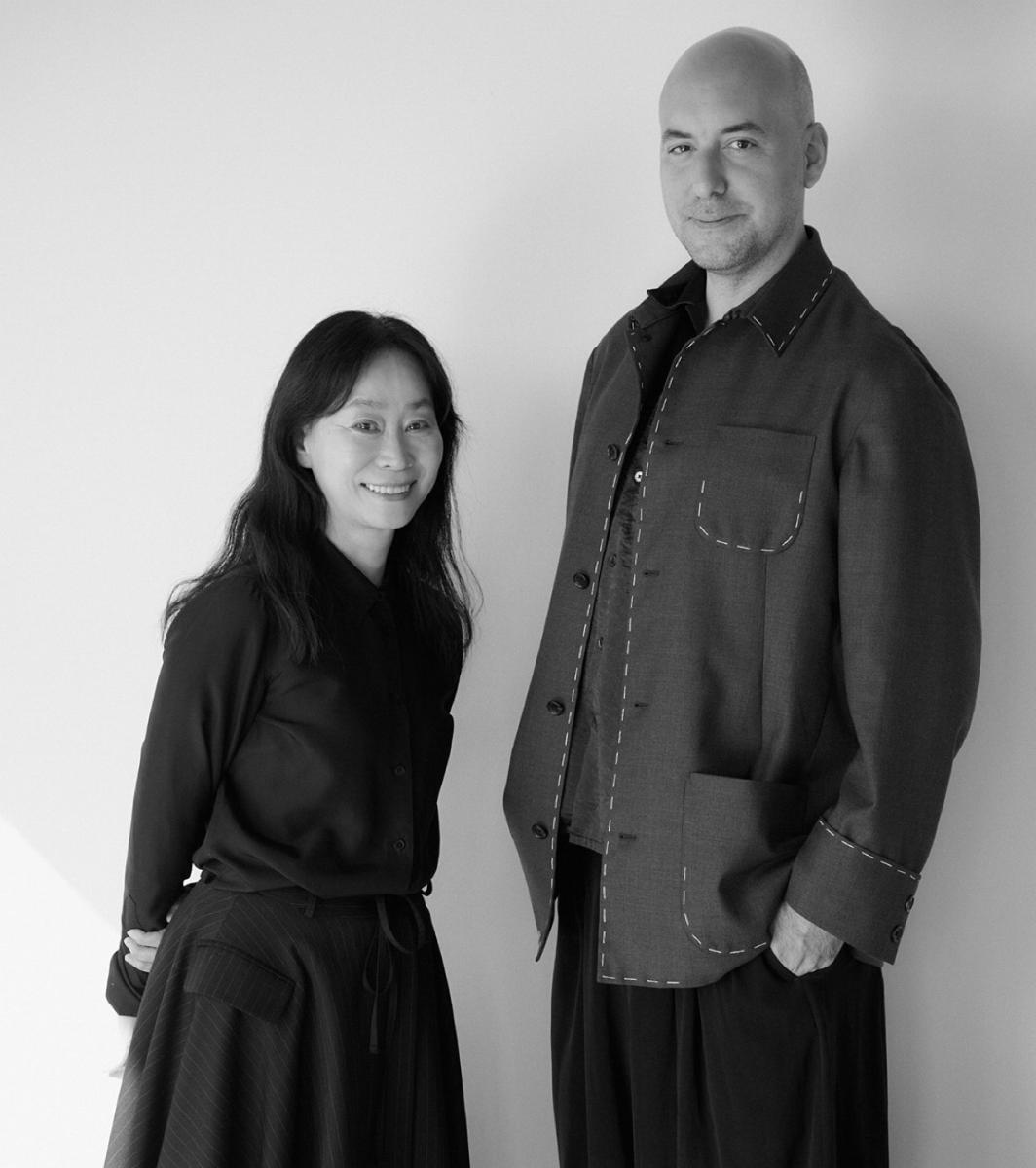
Kimchi and Chips is a duo who uses light to read poetry and invent technology to preserve letters that are facing extinction. True to their name, the duo comprises two individuals from different backgrounds who differ in every way possible—from the ways they communicate to their personal tastes—but have collaborated and fused their practices for sixteen years. Expanding the resonances between art and technology, their works have been exhibited in numerous galleries in both Korea and abroad and received multiple awards along the way. Their works currently displayed at Gallery Shilla, a new space in Itaewon, present new possibilities that diverge from the sense of wonder we felt when we first saw their work in open spaces. From Reworld, a work first presented at the Seoul Biennale of Architecture and Urbanism that has been transferred to the gallery’s glass window façade, to Unread Characters, a work that reinterprets the poet Yi Sang’s “Crow’s Eye View” through optical devices, to a project that uses AI to remember writing systems that are not encoded in Unicode—their projects don’t flaunt technology for its own sake, but rather operate as metaphors that reveal the structures of capital, labor, and the relations embedded into technology. In the AI era where it’s not an exaggeration to state that civilization itself is changing, Kimchi and Chips invites us to view technology not as an “object to be owned” but as a “network of relationships we must live with.” In this interview, we trace the world that Kimchi and Chips draws through technology—from their personal journey to their works exhibited at Gallery Shilla to the “festival of relations” they will present at Unfold X this year.
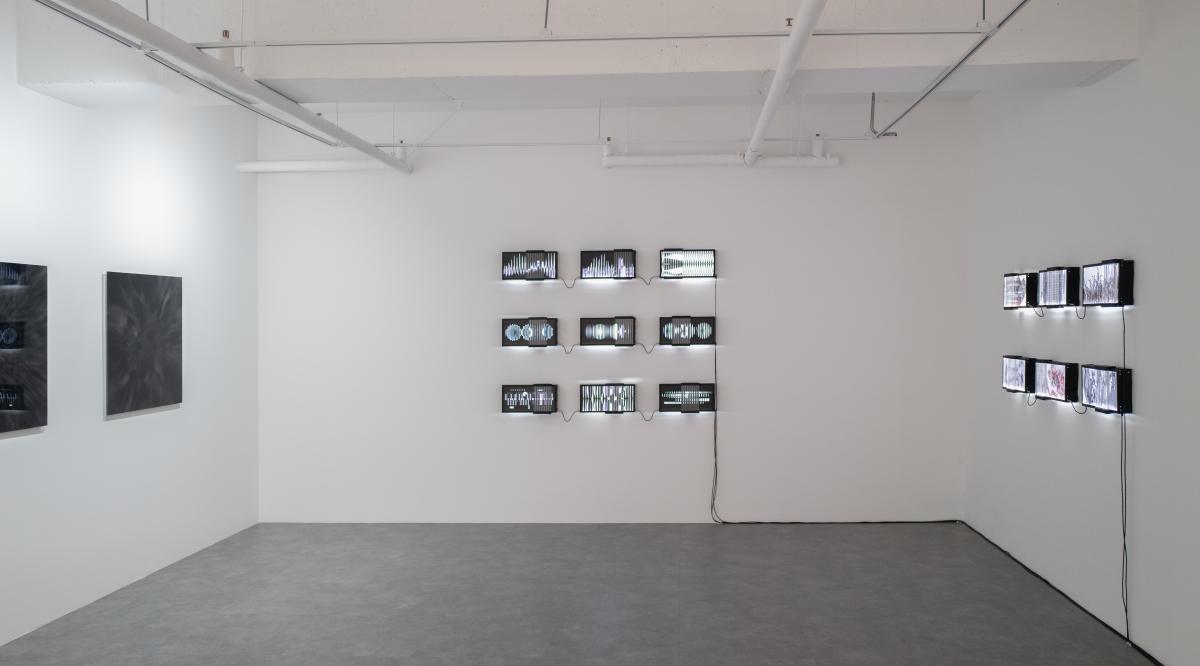
Exhibition view of Gallery Silla (7th floor)
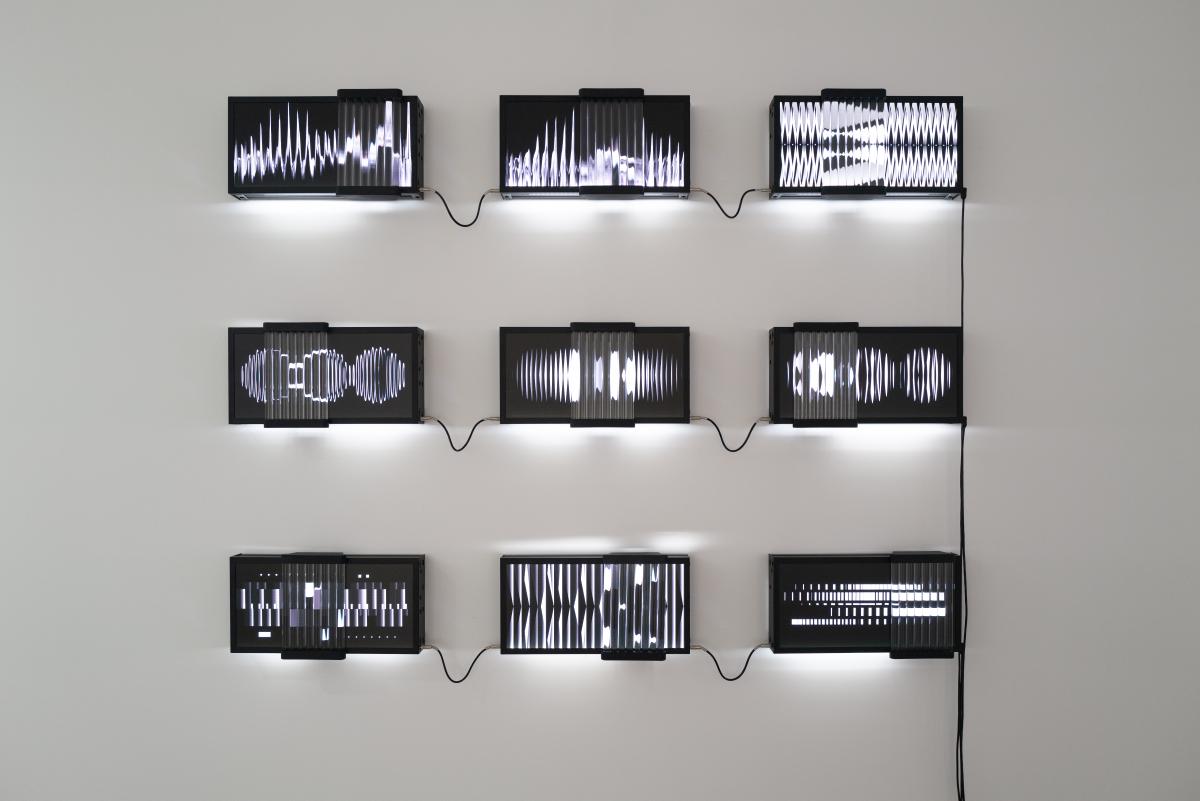
Exhibition view of Gallery Silla (7th floor)
Q. For your current exhibition at Gallery Shilla, you present three series—Optical Rail, Unread Characters, Reworld —in expanded forms. There must have been special significance to the location, since it coincided with Frieze Hannam Night and also takes place in the new venue for Gallery Shilla. How did you approach the exhibition and installation?
Mimi Son (Son): This time, we took works that were previously commissioned by larger institutions and focused on reconfiguring them into stable, collectable forms. Our projects are typically oversized in scale and require specific installation conditions. Completing a single piece takes a long time and this also means a large budget, so it’s almost impossible for anyone other than national museums or major institutions to collect our work. Consequently, after an exhibition ends, the chances of a viewer encountering our work again are very limited. So this exhibition was an experiment in exploring ways to present technology-based artworks to the audience in different forms. We wanted to test if we could create a sustainable framework for technology-based installation pieces that worked well with the gallery system and the interests of private collectors.
Q. It’s been over a month since the exhibition opened. Have you felt any palpable changes?
Son: Absolutely. The Korea Arts Management Service was intrigued by our experiment, and it inspired them to create a program where galleries in Samcheong-dong collaborated with media artists to showcase works that were actually “collectable.” We wanted to create a precedent where artists like us could separate their signature pieces from those available for sale—and the prospect seems promising.
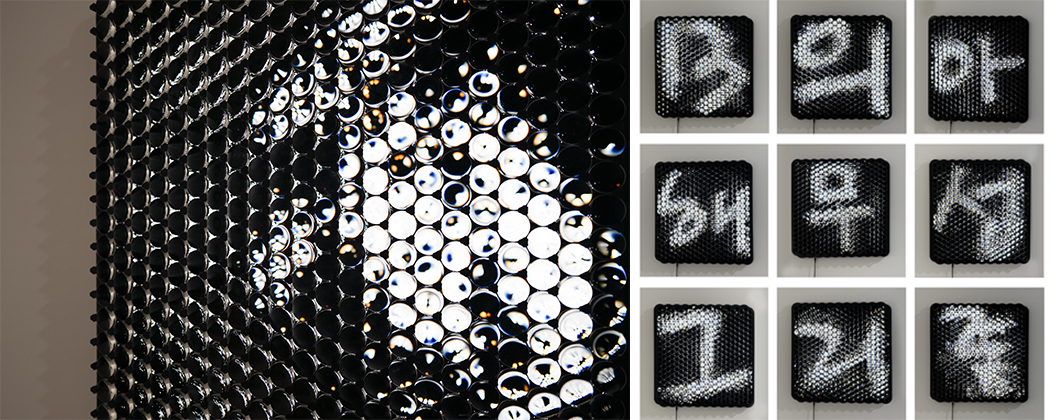
Unread Characters installed in 7th floor of Gallery Shilla ©Gallery Shilla
Q. Unread Characters does feel more accessible in terms of scale and form—it makes you actually consider acquiring the piece. How did the project begin?
Son: Unread Characters began with the support of Unfold X 2023. It started as a meditation on disappearing languages and alternative ways to archive them through technology. The new series presented at Gallery Shilla incorporates the poet Yi Sang’s “Crow’s Eye View.” I trained a machine learning model on the text of “Crow’s Eye View” that I handwrote on paper, and compressed the data into a single pattern. The pattern consists of small dots that resembles Braille. As the dots are magnified by the hundreds of lenses placed over them, they become letters and characters. As the viewer moves, the light refracts in different ways to reveal various letters and words.
Poetry is, at its core, a highly condensed form of language. We borrowed the idea of a “compressed format” and layered different sentences and meanings within a single pattern. Depending on where the viewer stands, the words may create a coherent meaning or seem completely misaligned. In either case, what’s important is that the “poetry” exists in implication. In that sense, the piece is about the existence of letters that can never be fully read.
Q. It feels so different to revisit Reworld in Itaewon after first seeing it in Songhyeon-dong. Considering how it is a work that reconstructs the setting and background, I’m curious what significance Itaewon holds as a place for Kimchi and Chips.
Elliot Woods (Woods): The Itaewon version was interesting for a different reason. The area is undergoing constant development, demolition, and redevelopment in real time, and it’s a place where diverse communities coexist—a mosque stands side by side with karaoke rooms, pubs, and transgender bars. Itaewon has been a site of experimental ways of living, as a historically affordable and international neighborhood. We love Itaewon and have many friends who live here, but some of them have been kicked out or are planning to leave because of the redevelopment. The fragmented history of the city, the displacements, the old residents who are leaving and the newcomers who are arriving—this mixed landscape was what we wanted to view through Reworld.
Son: We first presented Reworld at the 2023 Seoul Biennale of Architecture and Urbanism. Back then, it was a site-specific work. Songhyeon-dong is a space in the middle of the city that had been closed off for such a long time, and was then suddenly unveiled. When we began working on the project, we realized that the space had no memories, since it had been hidden away for so long. It was devoid of past experiences and lacked any current, everyday use. Yet, we had to envision Seoul’s future in 100 years, which was the theme of the biennale. To imagine the future in a place where both the past and present felt absent was in itself a riddle. Reworld is the result of our struggle with that riddle. The entire facade becomes a giant optical device, recreating images using everything that exists in the space: benches, flowers, the sky, clouds, trees, passersby, and even the changing light. The lens tilts1) and pans2), pulling in landscapes from here and there to reconstruct them into a mosaic. What we loved about installing Reworld in Itaewon was that the backdrop is also a place where things comingle, which perfectly matches the image we wanted to create with this piece.
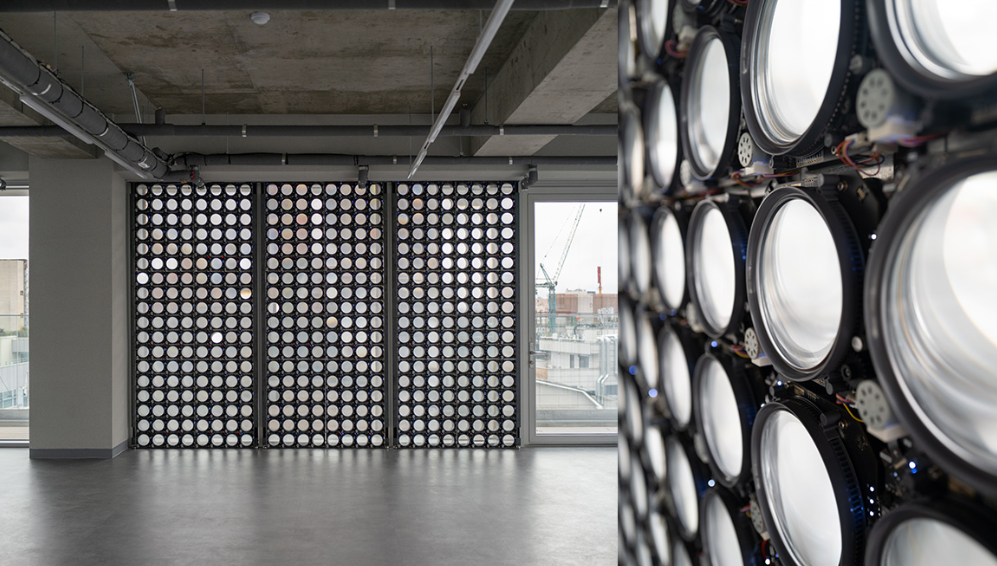
Reworld installed on the glass façade of Gallery Shilla’s 6th floor. The winter sunlight travels through the lens as it continuously reconstructs the outside scenery. ©Gallery Shilla
Q. This version of Reworld reconstructs its surroundings using artificial light at night, which offers a completely different experience from when it used natural light during the day. What sensory experience did you want to create?
Woods: We’ve used the idea of “drawing in the air” for many years across various projects. We first started with drawing spheres on fabric with light, then moved that piece indoors, then drew halos on mist, and later used the sky itself as a canvas. If the daytime version of Reworld used sunlight to continuously reconstruct the landscape, for the night version presented at Hannam Night, we literally installed an artificial “night sun.” The sun’s altitude now in November is much higher higher than in September when the exhibition first began, so we couldn’t achieve the look we wanted where the sun would shine through the prisms. Fortunately, down the street is the old gallery space where the director lives, and from there we could install a powerful searchlight on its rooftop that would a strong parallel beam of light onto the window that could imitate the sun.
Son: We also enjoy the idea of transformation ceremonies. For example, in 2015, when we transformed an old incineration plant in Bucheon into a cultural space called B39, we projected an image of the moon onto a fluttering piece of fabric. You can say the night version of Reworld is also a sort of ritual that transforms an existing space.
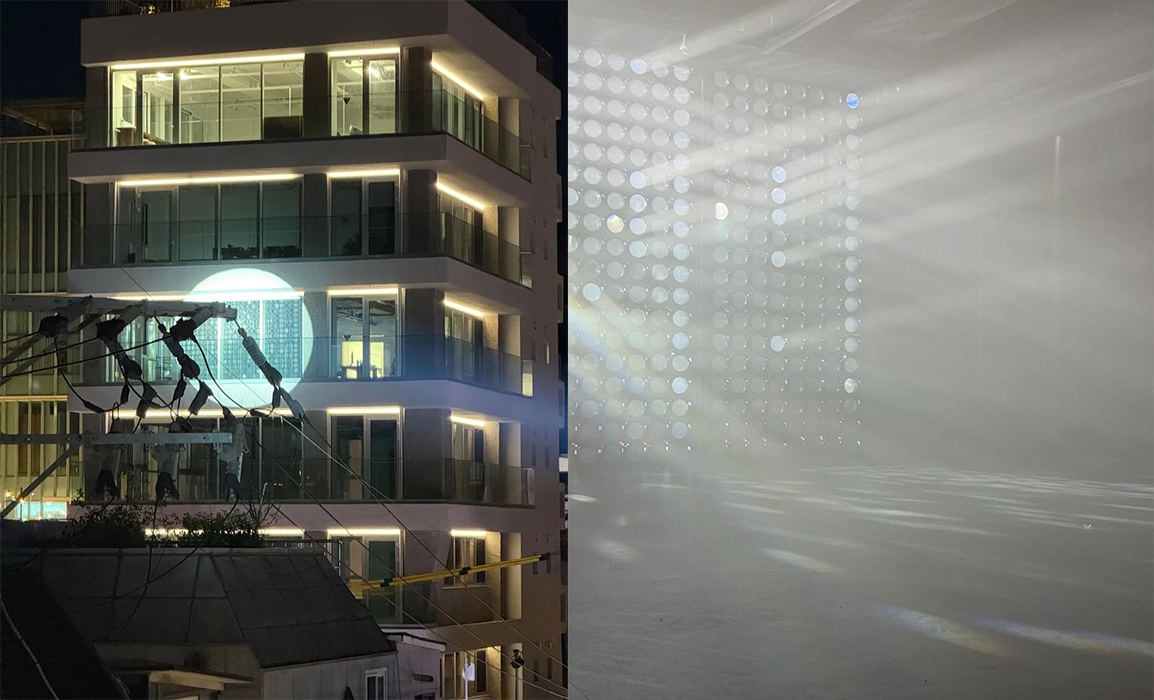
At night, the current installation at Gallery Shilla projects light directly, creating a different landscape from the day. ©Gallery Shilla
Q. You’ve continued to create works where the material and immaterial, light and matter coexist. I’m curious how the idea of “drawing in the air” has evolved over the years. Works like Halo and Another Moon feel sacred and spiritual in how they reinterpret the wonders of nature through technology, which is also the case with Reworld.
Son: When we first came up with the name “Kimchi and Chips” and casually started using the phrase “drawing in the air” as a slogan, we didn’t think we’d actually be drawing in the air. We didn’t have a specific outcome in mind when we came up with these names and phrases; in fact, it was the opposite. The two of us are different in almost every aspect—nationality, mother tongue, cultural background, ways of thinking, pace, approaches… We barely have anything in common. [laughs] We’re not a homogeneous duo with a unified vision, so we needed an abstract, undefined vision that we could work towards together. That vision was “drawing in the air.” Another internal rule we adopted was to “agree to disagree.” If we find ourselves agreeing on an idea too easily, we become skeptical and ask ourselves, “Are we trying to avoid the hard questions?” or “Are we settling for an easy compromise?” That’s why we maintain a certain gap and continue our work, whether that gap widens or narrows. And that’s how works like Halo, Another Moon, and Reworld naturally lined up. We first drew spheres in the air with light, which we then moved to the sky; the trajectory of the sun, clouds, fog, and light formed their own lineage. It’s not like we fulfilled our grand goal of “drawing in the air.” Rather, we’ve come to realize over time that the work we’ve done naturally coalesced into a single history.
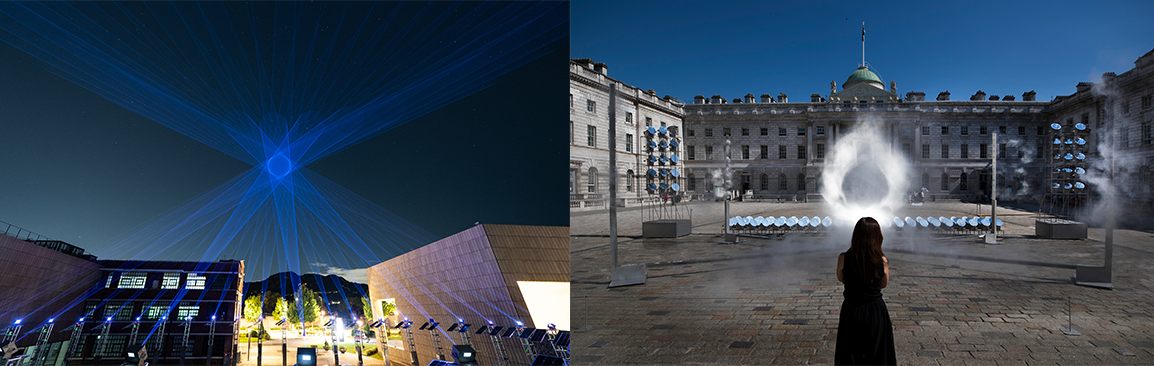
Installation of Another Moon in the courtyard of the National Museum of Modern and Contemporary Art. It projected light using solar energy collected during the day. ©Courtesy of the National Museum of Modern and Contemporary Art, Korea (left)
Halo presented at Somerset House, London, in 2018 © Kimchi and Chips (right)
Q. Kimchi and Chips has always used technology as a material for your projects. As AI rapidly infiltrates the art scene, do you view AI as a tool for art? As technology is evolving, some are concerned about the use of agentic AI in art. What values should artists pursue in the age of AI?
Woods: First of all, we need to rethink what we mean by “technology.” Technology isn’t merely a tool or machine. It’s a knowledge system where society, capital, law, platform, and labor are all entangled. Right now, technology exists as an additional layer stacked upon human civilization, which is why we cannot adequately explain this technology from our perspective “underneath it”, using human language alone. AI is no different. When we talk about AI image generators, we tend to ignore the industry, data centers, platform labor, and the massive flow of capital behind them. I agree, to a certain extent, that “AI is a new civilization,” but I no longer think today’s technology is “neutral.” Because capital moves technology and the ultimate goal of capital is the accumulation of profit, the structure of technology cannot be unbiased. In the past, we could see workers physically leaving a factory, but now, all that labor is hidden behind platforms and clouds. People work all night, yet all we see is a parcel that magically arrives at our doorsteps in the morning. Repeating questions such as “Will AI replace artists?” or “Will AI become a threat to the livelihood of artists?” without examining these structures overlooks the more difficult questions that need to be addressed, such as who designed this system, who profits, and who is doing the invisible labor. For us, AI is less a “creative tool” and more a vast metaphor that helps us understand the structure of the sum of all human activity. We hope we could create ways that help perceive that structure.
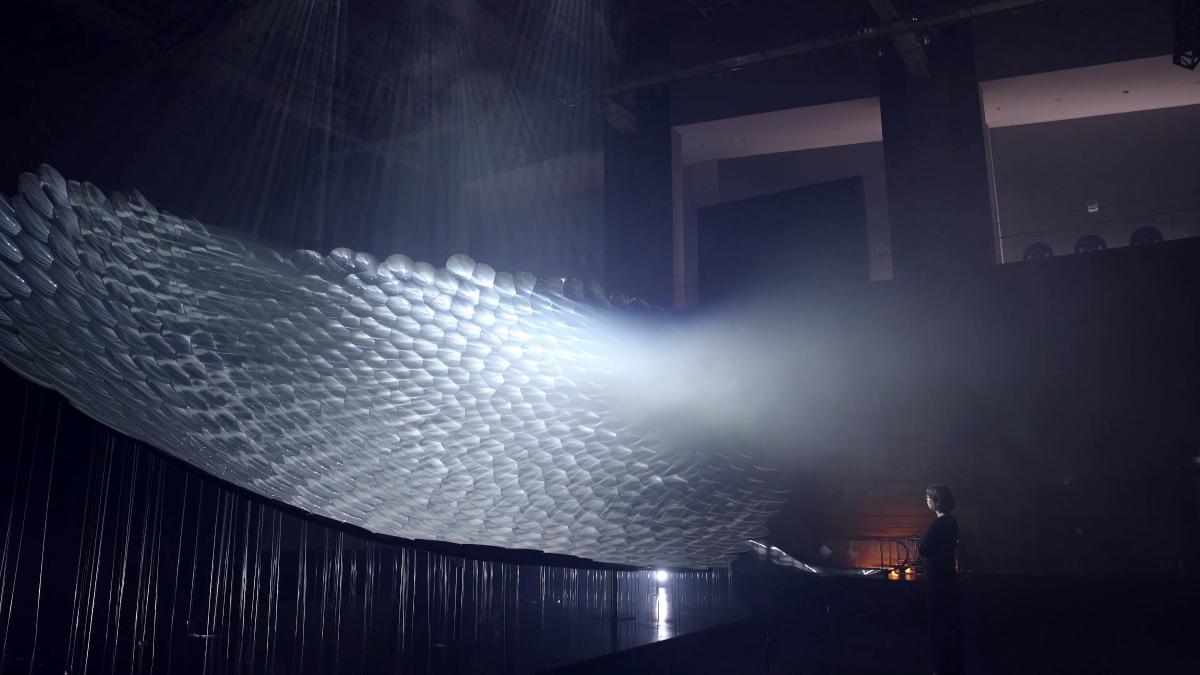
Light Barrier Type 2 (2016) installed at the National Asian Culture Center ©Kimchi and Chips
Q. You’ve been selected as the Art Director for Unfold X 2025. I was intrigued by the introduction you wrote: “Rather than focusing on technology as a tool for creating spectacle, [Kimchi and Chips] seek to expand its role as a medium for building ‘living, interdependent networks,’ envisioning a festival in which both human and non-human agents can actively engage and contribute.” Can you elaborate on your plans for the direction of this year’s festival?
Son: This year’s theme is “Letting Things Go : Relation of Relations.” We began by questioning the very essence of the festival format. Long ago, people looked at the moon and made strange gestures, began imitating each other’s movements, and turned that into song and dance—in other words, people gathered to share moments of collective joy. Over time, festivals turned into religious rituals, political events, and even promotional tools for capitalism. We asked ourselves if a festival could once again function as a space for social healing and bonding. That’s why I drew on Bruno Latour’s Actor-Network Theory, which views society as a fluid, constantly shifting network where various actors interact. And anything can be an actor, including animals, plants, chairs, spaces, laws, traffic lights, technology, and music. At Unfold X 2025, we invite all these actors to the festival. We wanted to create scenes where audiences and the works, music and space, institutions and technology all form relationships and, in turn, generate new relationships. One of the main pieces, Anouk Kruithof’s Universal Tongue, is an eight-channel video piece that collects dance footage from all around the world and meticulously synchronizes them to a single song. A diverse variety of movements that coexist in that piece. The English title, “Let Things Go,” is about accepting differences as they are, and the Korean subtitle, “Relations of Relations,” refers to how countless relationalities connect to each other. Over thirteen days, small and big events will happen across the festival, and audiences will be able to step directly into these networks of relations. Please come visit!
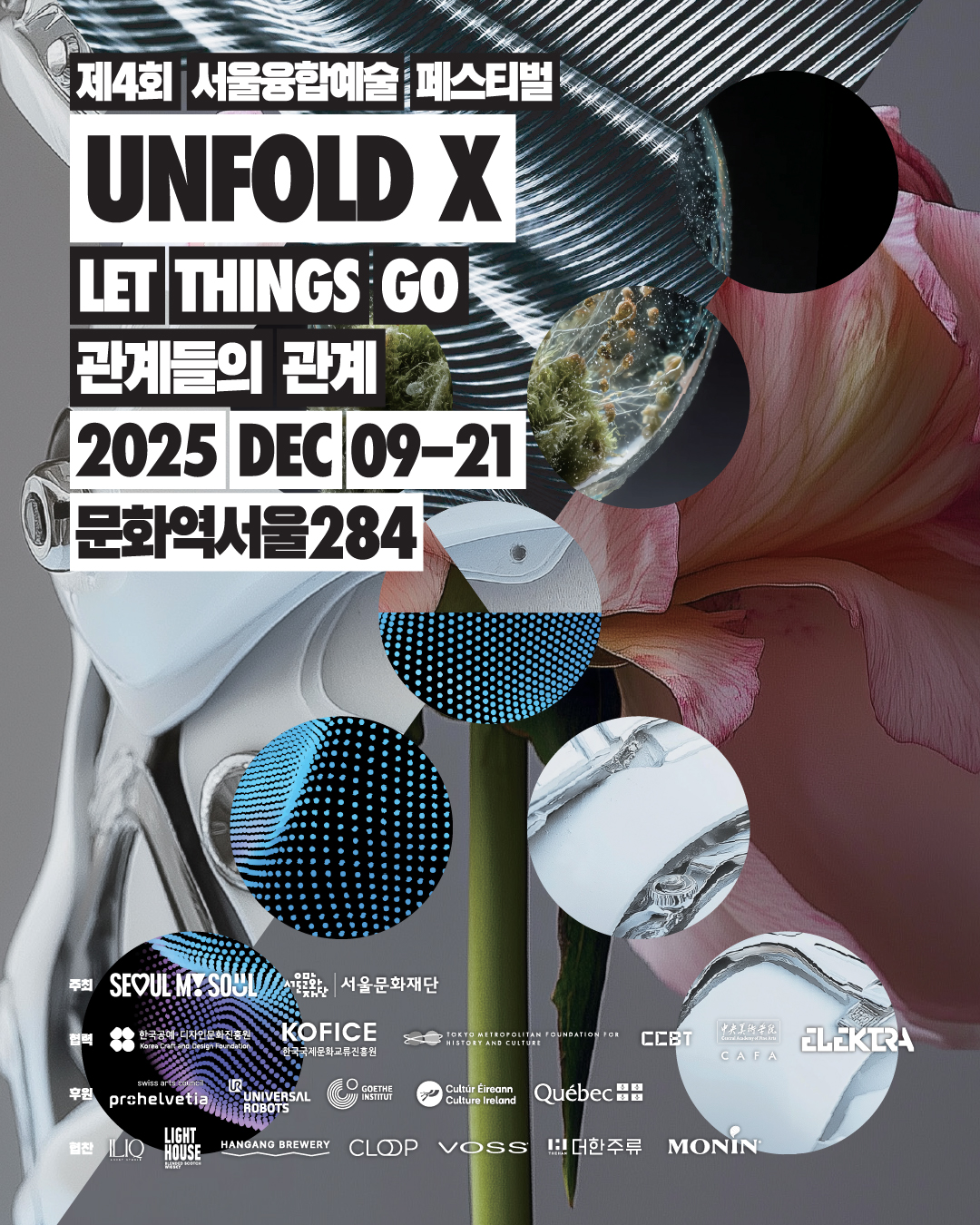
Poster for the 4th UNFOLD X Festival held at Culture Station Seoul 284
Q. In the meantime, technology has advanced at a rapid pace and the tools have evolved as well. I imagine the way you handle light and material must have also changed. Are there moments when you experience pure joy? Is your work becoming more enjoyable over time?
Woods: To be honest, during the process I am careful to avoid “pure joy.” The most immediate emotions I feel are relief and fulfillment. Because our works are so risky and challenging, we don’t even know if the final outcome will be successful until the installation is complete. The engineers and studio staff have no idea what the piece looks like while they work on it. So when the project is completed, the audience arrives, and we finally confirm that it operates properly—that’s the moment when I feel joy. Until that moment where everything is done, I consciously avoid joyful abandonment, and keep tweaking the details to make sure it hits the right note.
Son: My favorite moment is at the end of a project, when we take a group photo with all the staff and share it in the group chat. Our projects always require the talent of multiple people—engineers, programmers, technicians, installation crews, and operating crews. While we’re working, no one knows what the final piece will look like. There’s a moment at the very end when everyone looks at the finished piece and smiles, going “Ah, so this is what we’ve been working on!” Adding everyone’s names to the credits and seeing how that leads to other projects—I love the feeling of growing together and then growing apart. Our work is not a lonely act; it feels more like a space where people’s lives and paths momentarily cross.
Q. Do you have any ideas in development or projects in the research stage that use AI? Are there any new directions you want to explore with AI, robotics, or machine learning?
Son: Most of our projects are slow-paced. Another Moon took seven years from ideation to completion, and Halo required more than three years of preparation. Right now, we have a long-term project we’re planning to complete by 2030, but the commissioner hasn’t officially announced it yet, so we can’t share any details [laughs]. But we definitely want to continue working on such long-term, cumulative projects.
*tilt1) : a vertical camera movement where the camera rotates up or down on a fixed position
*pan2) : a horizontal movement in which the camera rotates right to left on a fixed position
에이스퀘어
편집부
좋아요
0
코멘트
작성하기